
JANUARY NEWSLETTER 2025
IN THIS NEWSLETTER...
VIP Wines of the Month
Report from the Tasting Room
Report from the Cellar
Report from the Vineyard
Report from Locksley Farmstead Cheese
Note from Jenni
January is here, and with it comes the dreaded chill of winter—a perfect excuse to pour yourself a glass of wine. While every season is wine season, cold weather has a way of calling for reds. Lucky for you, we happen to have a few of those around.
At Chrysalis Vineyards, we offer a great selection of red wines, from light and fruity to bold and tannic—there’s a little something to suit every palate. Norton lovers, fear not, we have that in spades so you know that we have you covered. Whether you're relaxing at one of our cozy heated tables or curling up next to a nice fire in the comfort of your own home, our wines are the perfect companion to warm up your winter days.
DECEMBER EVENTS:
January 30th @ 5PM - Book Club
Join us at Chrysalis Vineyards on January 30th, from 5 - 6 PM for Book Club! Sip on some great wine and dive into lively discussion about each month's read! This monthly gathering will occur on the last Thursday of every month and is completely free to attend. We are delighted to have the wonderful team from Loudoun County Public Library leading the discussions. This month the club will be doing a 'book tasting' where club members will get to vote on their next read after hearing a breif summary or each book. Come out and enjoy the fun!
Interested in attending? Reach out to Jill Smedley at
Jill.Smedley@TheAgDistrict.com.
NOTE TO OUR VIP CLUB MEMBERS
We invite our VIP club members to come and toast the new year with us on January 10th for a Sparkling VIP Club Pick Up Party! At this event, you'll get enjoy a taste or two of our sparkling line up and a delighful round of wine bingo. Members must RSVP no later than January 6th by emailing TR-Manager@Chrysaliswine.com. Please include your name, the number of people attending (up to 2 per membership), and which session you will be attending (5PM or 6:30PM). When planning your visit, please remember that we close at 8:00 pm.
Not a VIP Club member yet?
Learn more about the benefits below and join the club today!
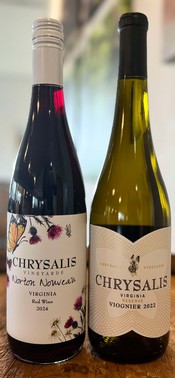
For January, our VIP members will receive the 2022 Viognier and the 2024 Norton Nouveau.
The 2022 Viognier is carefully crafted using 100% wild fermentation which produces fresh tropical aromatics. This wine is fermented in 100% neutral oak to increase “mouthfeel” richness and aromatics without any oak character. Batonnage is performed twice a week on each individual barrel until fermentation is complete (stirring up the lees, as with a “baton”). After fermentation, the wine is gently racked and batonnage is then performed once a week. This technique increases richness and enhances structure and complexity. When enjoying this wine you can expect aromas of tropical fruit, tangerine, and white flowers with notes of ripe peaches, sweet kumquat, and mango on the palate.
The 2024 Norton Nouveau is a nod to the world-renowned annual release of Beaujolias Nouveau but showcases the range of Virginia's beloved grape, Norton. True to the style's origin, we utilized carbonic maceration, an enzymatic reaction forced by an anaerobic environment, to draw out the true character of the Norton grape. It features aromas of red plum, figs, and lavender with flavors of blueberries, morello cherries, and a classic bubblegum finish on the palate.
As a reminder to our members, all VIP wine is available for pickup at the Ag District Center tasting room anytime during regular business hours.
NOTE: Please do not reply to this emailed Newsletter. Your email will not be handled in a timely manner or may even be lost.
REPORT FROM THE TASTING ROOM
New Year’s Greetings from the Tasting Room!
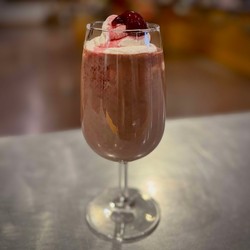
What’s NEW? Port Hot Chocolate!
This decadent drink is the ultimate treat to enjoy at one of our cozy heated tables on a sunny winter day! Crafted by one of our talented Wine Associates, this delightful creation features a rich homemade hot chocolate infused with our Borboleta Port-Style Norton. It's topped with a dollop of luscious whipped cream made with our Locksley Fromage and finished with a Port-marinated cherry for the perfect touch. And don't worry—we also have a non-alcoholic version for those under 21 to enjoy!
There is so much to celebrate in the new year, let us be a part of your celebrations! Reach out to me, Lori Tate at TR-Manager@ChrysalisWine.com, and let’s talk about how we can help you celebrate your special occasion at Chrysalis Vineyards.
Reminder: Our Norton Nouveau is still available but only while supplies last! Swing by Chrysalis for a glass (or bottle) to get it before it’s gone! Hope to see you in the Tasting Room soon.
Wishing you and yours a healthy and prosperous New Year!
- Lori Tate, Tasting Room Manager
REPORT FROM THE VINEYARD
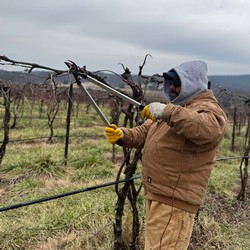
January marks the beginning of the pruning season. That’s right, we finished harvest, made some wine, the crew put all the vineyard equipment away, winterized the vineyard, and now they’re right back at it! Do they take a break? Yes. How long? Not long enough—but that’s why they’re the best.
Many of you know that we start pruning our Norton first. There are a couple reasons why we do this. It’s partly because we have 40 acres but the other reason may fascinate you more. We actually have a particular order we prune the vines and it’s according to when they break bud and when they are harvested. For instance, the first thing we pick is Albariño but the last thing we prune is Albariño.
This is due to a varietals “vigor” or rate at which it grows. Varietals like Norton are incredibly vigorous and need significantly less time to grow new shoots, leaves, and fruit. In fact, because of the vigor of Norton we actually have to use different trellising to help combat the vigor. Varietals such as Albariño, Petit Manseng, and Viognier, are considered medium vigor which essentially translates to, “telling someone an appointment is happening 30 minutes earlier then when they actually need to arrive because you know they’ll be late anyways”. Unlike Norton which is always on time and ready to be picked in October.
The order of pruning is assigned according to when a varietal breaks bud and its “phenology”. Phenology refers to predictable periods of biological life cycles or in common tongue, when a vine will break bud, when it will produce fruit, and when that fruit will be ready. This is usually in a range of time, for instance, Albariño breaks bud early April and Norton breaks bud at some point in May.
There are many factors that affect when a vine will break bud ranging from temperatures, rain, pruning practices, and even age of the vines. All these variables work to together like pieces of a puzzle, each one affecting when things happen. Luckily for us, we have Freddy who has worked here for 24 years, ensuring that all our vines are cared for properly.
- Jake Blodinger, Winemaker
REPORT FROM THE CELLAR
2024 was a good year to say the least. Looking back, we accomplished several feats: utilizing our new bottling line to have full control over our production, winning a gold medal in the Virginia’s Governor’s Cup, starting the Norton Network, and with Jill’s hard work launched the first ever Norton Wine Tour. Oh! We also released the first ever Norton Nouveau, the fastest wine in Virginia! A lot of firsts in 2024 to celebrate!
The 2024 vintage was challenging and really tested our skills here in cellar. Between the crazy cold temps at the beginning of the year, the drought in the summer, and hurricane season during harvest, we had to really think about what we do and why we do it. This year made us dive into the old winemaking tool box and try some unusual techniques to improve quality. Nonetheless, we crafted some amazing wines, learned some new tricks, and even made some potential new discoveries about our own vineyards, but more on that later…
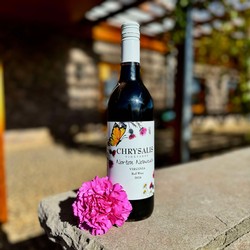
So, what’s next? Well, to be honest with you…you’ll just have to wait and see. Everyone here at Chrysalis Vineyards is working on something new, there are lots of great ideas and not enough hours in the day. I promise that we will continue to bring quality wines to your glass, have great times while you are here, and find new ways to share what we do with you.
In the meantime, I would challenge you to find a few new favorite Chrysalis Vineyards wines and bring them home with you to enjoy. Share them with friends and family, talk about why you enjoy those wines, pair them with meals, and just have fun. 2025 is a new year and there many things to come but for now, just take your Chrysalis Wines wherever you have fun. Happy New Year!
- Jake Blodinger, Winemaker
REPORT FROM LOCKSLEY FARMSTEAD CHEESE COMPANY
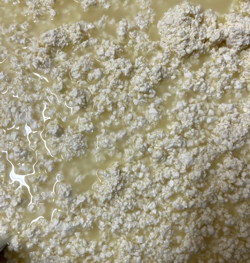 Little Miss Muffet sat on her tuffet, eating her curds and whey... huh? What are curds and whey... or a tuffet for that matter? Here at Locksley Farmstead Cheese we don't have alot of time to sit on our tuffets, but we do work with curds and whey almost every day!
Curds and whey are produced when cultures, enzymes and rennet are added to our pasteurized milk. The curd is formed when these components cause the casein protein and fat in the milk to coagulate. The solid particles that are produced from this coagulation are the curds and the remaining liquid is the whey. When we make our cheeses we drain off the whey before placing the curd in moulds. Depending on the type of cheese that we are making, the curd is the pressed or drained more in the mould to remove more whey.
So why was Little Miss Muffet eating curds and whey? Well, she might have dipped into the vat before the whey was drained off or she may have actually been eating cottage cheese. The whey that is the byproduct of cheesemaking contains other proteins that don't coagulate to create the curd in the initial process along with some minerals and amino acids. Cottage cheese is produced by adding different cultures to the whey and heating it to create a secondary coagluation. The soft curds that are created are strained and salt and cream are added to created cottage cheese!
- Teri Scott, General Manager

Ya’ know, they don’t let me off the farm very often, but sometimes I sneak away! No… that’s not true. I’m always being encouraged to go and have some fun, get away… you know, “get out of Dodge” for a few days. And I agree that taking a few days off is always refreshing and revitalizing. So it was with my latest “get-away”.
On my latest trip, I went to Veneto, Italy with my friend Dr. Bruce Zoecklein, along with a bunch of winery folks on one of Bruce’s Wine-Study Tour programs. I had done this once before in December, 2002. So, it had been 22 years since I last participated in one of these programs. Indeed, this one was special, and I couldn’t resist, especially when I learned that my best buds, Andrew and Patricia Hodson, of Veritas Vineyards, were going. And we had a LOT of fun.
Dr. Z is the Emeritus Professor of Grape Chemistry and Enology at Virginia Tech, having completed more than 30 years as Virginia’s State Enologist. In addition, Bruce is currently the research coordinator for Applied Research Cooperative (ARC), a federation of wineries in California, Oregon, and Washington. Needless to say, Bruce knows a LOT about wine. The programs organized by him and Dr. Pascal Durand from the University of Burgundy are always fantastic. They take us to renowned wineries and superb restaurants offering the best regional cuisine. Perfect.
Anyway, we visited 13 top-flight wineries in the grapegrowing regions of Veneto. These included Soave, Valpolicella, Bardolino, Alto Adige and the Prosecco wine region.
I’m duly refreshed and looking forward to a fantastic New Year at The Ag District. And here’s hoping y’all have a healthy and successful 2025.
Take Care,

Jennifer McCloud
Chrysalis Vineyards at The Ag District
39025 Little River Turnpike (Tasting Room/Creamery/Kitchen)
23876 Champe Ford Road (Winery/Milking Center/Offices)
Middleburg, VA 20117
McCloud@ChrysalisWine.com
Office: 540-687-8222
www.ChrysalisWine.com
Facebook.com/ChrysalisVineyards